
POP Series 5: the holos never came from boosters
Not a single card in POP 5 boosters was holo, not even the Gold Stars. The holo versions of Ho-Oh, Lugia and friends are promos from 2007 US gift packs.
POP Series 5 was released in 2007 with 17 cards and handed out through Pokémon Organized Play, at tournaments and league nights. No card in those boosters was holo: Ho-Oh, Lugia, Mew δ, Pikachu, Pelipper δ and Zangoose δ are regular non-holo cards there.
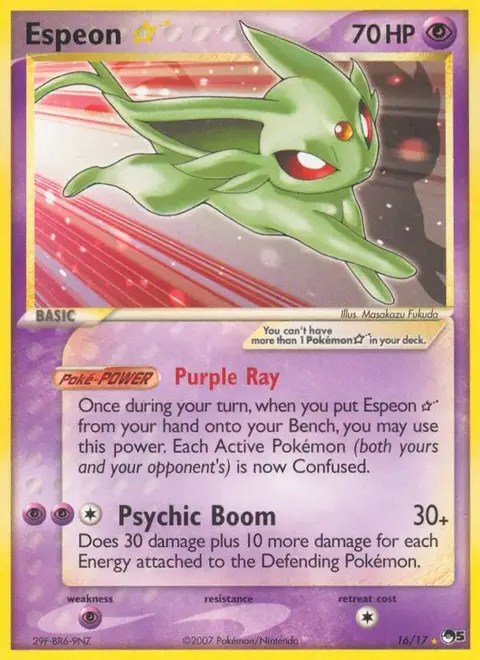
That even goes for the two Gold Stars, Espeon ★ 16/17 and Umbreon ★ 17/17. Their Japanese originals, fan club promos from 2005/06, are holo; the western POP 5 prints are not. PSA still prints “Holo” on the label, so don't let that confuse you.
The holo versions of these six cards are really promos. Ho-Oh, Lugia, Pelipper δ and Zangoose δ came in the DP Gift Blisters and DP Gift Boxes in October 2007 (Target, Toys R Us): Ho-Oh and Lugia as Cosmos holo with a circle-and-sparkle pattern, Pelipper δ and Zangoose δ as smooth mirror holo. Mew δ and Pikachu came as Cosmos holo in the DP Value Pack 1 in September 2007 (Wal-Mart, Target).
These packs were US-only and English-only. POP Series 5 was also released in German and Italian, but only as the booster version. A German Lugia 2/17 is therefore always non-holo.
Many copies of the holo Pikachu 12/17 were printed with the card back upside down. Flip the card over and you will see it right away.
Cards affected

 #1 ·
 #2 ·
 #3 ·
 #12 ·
 #14 ·
 #15 ·
 #16 ·
 #17 ·
More entries
- EX-era secret rares: 19 cards beyond the set sizeEleven English EX sets from 2003 to 2007 have 19 secret rares between them, cards numbered beyond the set size such as 100/97. Ten of them came as box toppers on top of the booster box, the other nine were, as far as is known, found in booster packs.
- Red Cheeks Pikachu: why the Base Set Pikachu exists twicePikachu 58/102 exists with red and with yellow cheeks. Red only appears in the earliest English prints and costs many times more as a PSA 10.
- How to identify 1st Edition cards: stamp, sets and fakesA 1st Edition card comes from a set's first print run and carries a black stamp with a “1” below the artwork on the left, used on only ten English Wizards sets and some translations.
- Grading explained: PSA, BGS, CGC and the restA grader checks a card for authenticity, scores its condition and seals it. A 10 means something different at every company, and it is often worth a multiple of the raw card.
- How to read a Pokémon card: number, set symbol, holo, reverse holoThe bottom line of a card tells you its set, number, rarity and tournament status, and the shine tells you which version it is.
- Pokémon card condition: Near Mint, Lightly Played and the restUngraded cards sell by condition grade, but Cardmarket, TCGplayer and eBay mean different things by similar names, and condition can move the price by up to two thirds.